
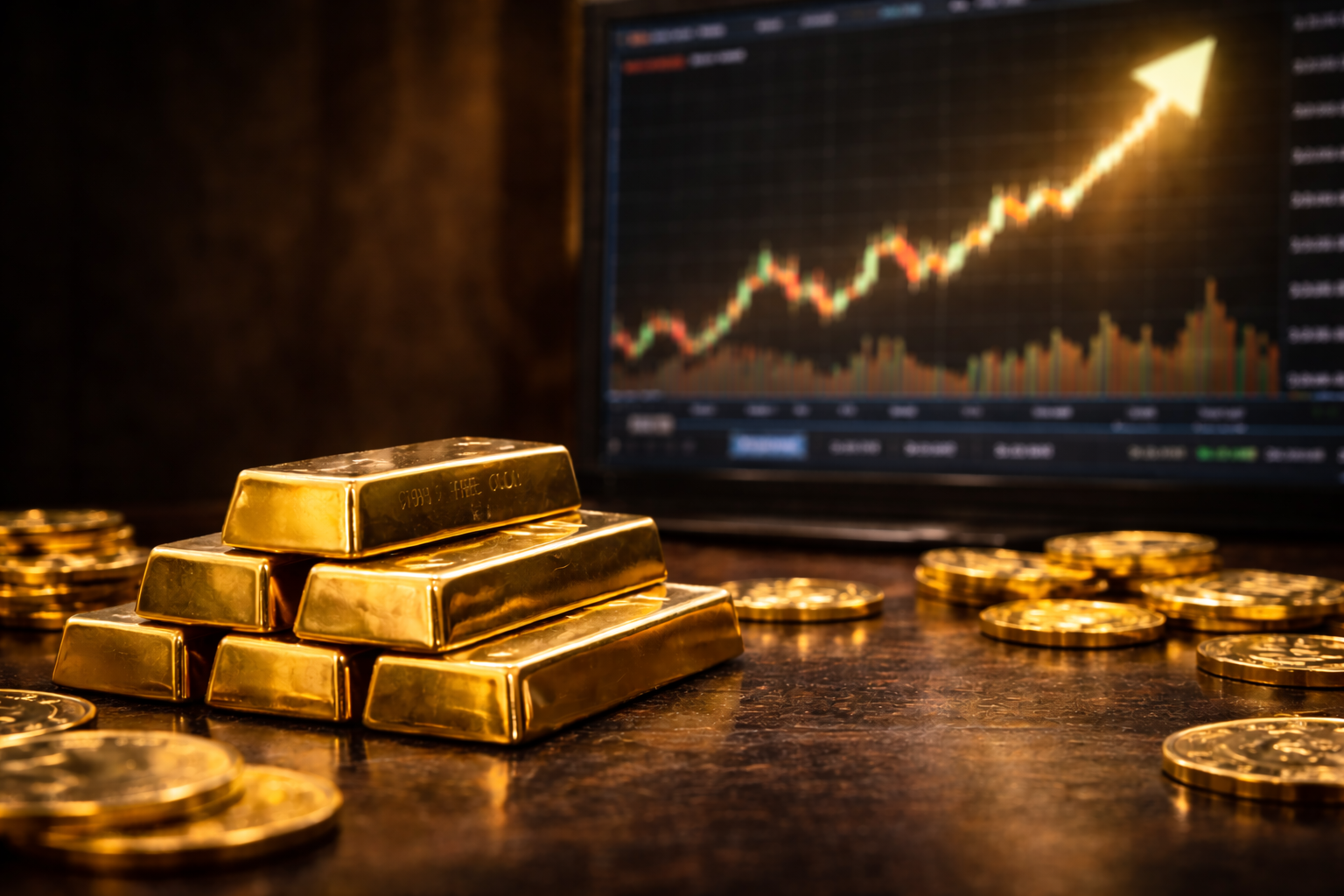
At current levels, gold reflects both fear-driven flows and structural repricing with a move towards $6,000 looks realistic in the near future, says B2PRIME Group’s Eugenia Mykuliak.
Invezz spoke with Mykuliak, founder and executive director of B2PRIME Group, a global financial services provider for institutional and professional clients, in an exclusive interview to discuss price trajectories, Fed policy shifts, liquidity risks, and positioning strategies for 2026.
Mykuliak highlighted that gold’s climb to $5,600 (in prior peaks) reflects not just fear but a structural repricing driven by long-term macro risks.
She views a move toward $6,000 in the near term as “quite realistic,” especially if uncertainty persists. Major forecasts align with this optimism: institutions like J.P. Morgan targets $6,300 by end-2026, UBS $6,200, and Wells Fargo recently lifted its year-end outlook to $6,100–$6,300, citing sustained central bank buying and investor demand.
Silver, meanwhile, benefits from surging real-world applications in semiconductors, EVs, AI infrastructure, and renewables — with supply remaining tight.
Mykuliak expects decoupling in 2026: gold outperforming during stress periods, silver moving independently on tech and energy growth.
Some analysts eye silver pushing toward $100+ sustainably, with extreme scenarios even floating $200 in speculative squeezes.
The Fed chair nomination of Kevin Warsh — an inflation hawk — is shifting expectations toward a more flexible policy stance, keeping real yields suppressed and supportive of precious metals.
Tokenised gold’s TVL explosion past $4 billion signals institutional positioning, while India’s resilient cultural demand and ETF inflows add further tailwinds.
In this environment, Mykuliak stresses flexibility, reliable execution, and tight risk controls for traders as gold flashes early liquidity warnings.
With inflation now structural and de-dollarisation accelerating, gold and silver stand out as neutral, independent stores of value — poised to sustain buying pressure into 2026.
Gold on COMEX last traded at $5,069 per ounce, while silver was at $81.597 per ounce. Last month, prices had reached unprecedented record highs of $5,600 for gold, and $121 for silver.
Below are edited excerpts from the interview:
Invezz: With gold hitting a record $5,600 and silver $121, how much higher can both climb in 2026 if macro uncertainty persists?
Eugenia Mykuliak: Gold at these levels reflects both fear-driven flows and a structural repricing. As an eternal shield against crises — amid geopolitical risks, US debt dynamics, and currency stability concerns — gold should keep growing confidently.
Looking from where we are now, a move towards $6,000 in the near future looks quite realistic.
Silver’s case is slightly different at its foundation, but the metal’s continued growth is just as likely.
Unlike gold, silver’s price is tied to real demand: namely, its use in fields like semiconductors, electric vehicles, AI infrastructure, and renewable energy.
If industrial demand remains strong and supply stays tight — and right now it certainly looks that way — silver will remain elevated.
Interest rate outlook and new Fed Chair nominee
Invezz: The new Fed chair nominee is shifting expectations — how are markets pricing the interest rate outlook for 2026, and what does it mean for precious metals?
Eugenia Mykuliak: While no formal policy shift has occurred yet, Kevin Warsh’s nomination is something that markets are in the process of digesting.
Expectations now lean toward a less rigid Fed, with a slower, more flexible approach to rate cuts and greater tolerance for above-target inflation.
This keeps real yields under pressure without fully restoring growth confidence — a supportive environment for gold as a neutral store of value amid monetary stability questions.
Silver benefits indirectly: industrial demand tends to hold up even in uncertain rate environments, especially if policy allows continued infrastructure and tech investment.
Gold as risk barometer
Invezz: Gold is acting as the first risk barometer again — when liquidity starts to crack, what typically breaks first in markets?
Eugenia Mykuliak: Liquidity itself breaks first: spreads widen, execution becomes uneven, and depth vanishes.
Then leveraged positions suffer most — in derivatives, high-yield credit, and smaller equities. Trades still execute, but at worse prices with more slippage.
Gold is good at acting as a “risk barometer” because it often moves first to absorb defensive flows before stress becomes visible elsewhere. Investors don’t tend to wait for sell-offs — they start reallocating to gold as soon as confidence weakens.
By the time equities or credit react visibly, gold has often already flagged changing liquidity conditions.
Invezz: How should traders position themselves when gold flashes early risk signals, and liquidity thins out?
Eugenia Mykuliak: The most important thing in such situations is to stay flexible. The quality of liquidity — how quickly positions can be adjusted, and under what conditions — is the key factor.
In a stressed environment, the biggest question traders ask is not whether a position is theoretically profitable, but whether it can be adjusted predictably and without triggering additional risk.
Instruments that look liquid in calm markets can behave very differently once volatility rises, and depth can vanish in minutes.
Gold giving risk signals doesn’t automatically mean that markets are about to collapse. Nor does it mean that you should be selling everything and exiting in a hurry.
But it does indicate that confidence is weakening and that liquidity conditions are likely to become less forgiving.
In such cases, it’s a good idea to tighten risk controls and focus on instruments with reliable execution in the short-term horizon.
The ability to transact during volatile periods allows traders to stay engaged while managing risk effectively, which is less likely to leave them trapped when markets move abruptly.
Gold/silver decoupling in 2026?
Invezz: Silver’s industrial demand is surging alongside its hedge role — how do you see it decoupling or syncing with gold in 2026?
Eugenia Mykuliak: Gold and silver are fundamentally different: gold as a crisis hedge, silver as an industrial metal. Decoupling is highly likely in 2026.
Gold should outperform during market stress. Silver could move independently during production growth or renewed tech/energy infrastructure investment.
Invezz: Tokenised gold TVL has exploded to $4B+ — is this retail flight to safety or institutions quietly building positions?
Eugenia Mykuliak: It has the influence of both of those factors, but institutions are playing a larger role. Retail investors are attracted by accessibility, but the scale and consistency of inflows that we’ve been observing point to professional allocation strategies.
Tokenised gold fits well into institutional workflows — it offers exposure to physical gold while integrating with digital settlement and custody systems.
This is part of how capital markets are modernising rather than a purely speculative trend. And we can fully expect this trend to continue.
Invezz: In this volatile environment, is gold outperforming other safe havens like bonds or the dollar?
Eugenia Mykuliak: Yes, and there are clear reasons for that. Bonds are still vulnerable to inflation surprises and debt concerns.
And the acceleration of de-dollarisation means that the US dollar’s role as a universal safe haven has weakened. Investors are more selective about when to rely on it for protection, and the use of alternative settlement currencies is growing.
Gold, on the other hand, stands independent from all of that. Its value is not tied to policy credibility, interest rate expectations, or political outcomes.
It outperforms other defensive assets because it offers neutrality above all.
India’s precious metals outlook
Invezz: India’s gold imports jumped 30% last year — how exposed is the local market to global price swings in 2026?
Eugenia Mykuliak: When it comes to gold, India remains a highly import-dependent market, so it’s unavoidable that it’s highly affected by global prices. But, I would argue that the full story here goes deeper than that.
What matters more in this case is the structure of demand — a lot of India’s gold demand is long-term in nature rather than speculative.
It is purchased for deeply-entrenched cultural purposes: wedding jewelry, festivals and religious ceremonies, household investments, and other such uses.
That provides some stability during volatile periods, as buyers in this part of the world are less sensitive to day-to-day price fluctuations.
That said, higher prices do affect timing, as purchases may be postponed until a later point in time.
The underlying demand remains resilient, but temporary pauses in imports and shifts in supply dynamics are possible from time to time.
Invezz: With rupee strength and rising silver jewellery demand, what’s your near-term outlook for India’s physical precious metals trade?
Eugenia Mykuliak: A stronger rupee can help absorb part of the global price increases for local buyers, making imports more manageable.
And it’s true that silver, in particular, stands to benefit from the ongoing situation, both in terms of changing consumer preferences and price dynamics. As gold prices stay elevated, more people turn to silver for jewelry and gifts, which helps its momentum.
That said, volatility remains a prominent source of danger. Sudden global price swings can disrupt import chains, inventory management, and delivery schedules necessary for physical trade.
This leaves smaller participants especially exposed, as they have less flexibility in hedging options, often being forced to pause trading or reduce volumes to manage their risks.
Stability in currency markets is just as important as metal prices themselves. Since most precious metals are priced globally in dollars, fluctuations in local exchange rates directly affect import costs and cash flow.
On the other hand, even if global metal prices remain elevated, so long as the exchange rates remain predictable, it should allow traders, jewelers, and importers to plan with greater confidence.
Inflation hedge and ETF demand
Invezz: Amid geopolitical tensions and AI-driven energy needs, could gold and silver sustain buying pressure as inflation hedges?
Eugenia Mykuliak: Yes — inflation is now structural. AI/data centers and electrification drive rising energy demand. Geopolitical tensions are a prolonged reality.
Gold gains from macro uncertainty; silver from infrastructure scaling for new technologies. Both should see sustained demand despite fluctuations.
Invezz: What kind of impact will ETF inflows have on the market this year as investment demand continues to grow?
Eugenia Mykuliak: I expect that ETFs will continue to be the primary channel for institutional demand into metals markets. Institutional players increasingly prefer ETFs because they offer operational simplicity and flow quickly at scale, allowing investors to adjust exposure quickly in response to changing macro factors.
That said, this also means that metal markets have become more sensitive to macro headlines. And it’s important to remember that the same mechanisms that allow rapid inflows also enable fast reversals.
In other words, when headline-driven sentiment shifts, ETF outflows can take place very quickly, and market participants now need to adapt to faster interchanging of risk and opportunity. That makes proper liquidity management and execution infrastructure more important than ever.
The post Interview: $6,000 gold realistic as macro risks fuel rally: B2PRIME’s Mykuliak appeared first on Invezz
